UAE Corporate Tax: 2026 Guide for International Founders

The honeymoon period for tax-free business in the Emirates is officially over. If you're still operating on 2022 assumptions, you're risking a 10,000 AED penalty just for missing a registration window. It's a blunt reality that's catching many international founders off guard.
You likely moved your operations here for the efficiency and the growth potential. Now, the introduction of uae corporate tax feels like a layer of friction you don't have time to manage. The fear of unexpected bills or getting stuck in the EmaraTax portal is a valid concern for any busy founder.
This guide provides a clear, jargon-free roadmap to navigate the 2026 landscape. You'll learn how to qualify for the 0% bracket, when the Small Business Relief expires, and the exact steps to keep your bank account healthy. We're moving from confusion to a structured plan for your profits.
Key Takeaways
- Understand how the 9% uae corporate tax only triggers once your annual profit crosses the AED 375,000 threshold.
- Identify if you qualify for Small Business Relief to maintain a 0% tax liability on revenues up to AED 3 million through 2026.
- Learn the mandatory steps for EmaraTax registration to avoid the fixed AED 10,000 penalty for late applications.
- Clarify the requirements for "Qualifying Income" to ensure your Free Zone entity actually benefits from the 0% rate.
- Establish a clear filing timeline to keep your corporate bank account in good standing and avoid regulatory flags.
UAE Corporate Tax in 2026: The Basics for Founders
If you arrived in Dubai expecting a total tax vacation, you're a few years too late. The landscape has shifted. The uae corporate tax is now a standard 9% levy on business profits, marking the end of the "zero-tax" era for most established companies. It's a structural change designed to align the country with global OECD standards and ensure the UAE remains a top-tier financial hub.
This tax applies to almost every commercial entity. Whether you operate a Mainland company or a Free Zone setup, you're now part of the federal tax system. However, the system is designed to be founder-friendly. Your personal income, including your salary, dividends, and personal investment returns, remains at a 0% tax rate. The focus is strictly on business profits.
Understanding the framework is the first step toward protecting your margins. For a broader context on how these changes fit into the local economy, this Overview of UAE Taxation provides a look at the transition from a non-tax environment to the current regulated model.
Why the 0% Tax Haven Myth is Dead
The UAE is now a low-tax jurisdiction, not a zero-tax one. This shift was necessary for global banking survival. International banks now demand transparency and tax residency proof before they'll even consider opening or maintaining a corporate account. If you want to keep your capital moving, you must participate in the system.
Compliance is mandatory, regardless of your bottom line. Even if your business qualifies for a 0% rate through specific reliefs, you are still required to register and file returns. Silence is no longer an option. Failing to register through the EmaraTax portal is a fast track to heavy fines and frozen bank accounts.
Who is Subject to Corporate Tax?
The law casts a wide net, but it categorizes taxpayers into three distinct groups. Knowing where you fit determines your registration timeline and documentation requirements.
- Resident Juridical Persons: This includes every company incorporated in the UAE, including those in Free Zones.
- Non-Resident Persons: Foreign entities that have a Permanent Establishment (PE) in the UAE or earn income from UAE sources.
- Natural Persons: Individuals (freelancers or sole traders) who conduct business activities in the UAE.
For individuals, the uae corporate tax only applies if your annual turnover from business activities exceeds AED 1 million. If you're just drawing a salary from your own company, that income stays in your pocket untouched. To ensure your company is structured correctly for these new rules, reviewing your corporate setup options is a practical next step.
Now that you understand who the tax applies to, we need to look at the specific numbers that trigger your first payment.
The 9% Threshold: Calculating Your Taxable Income
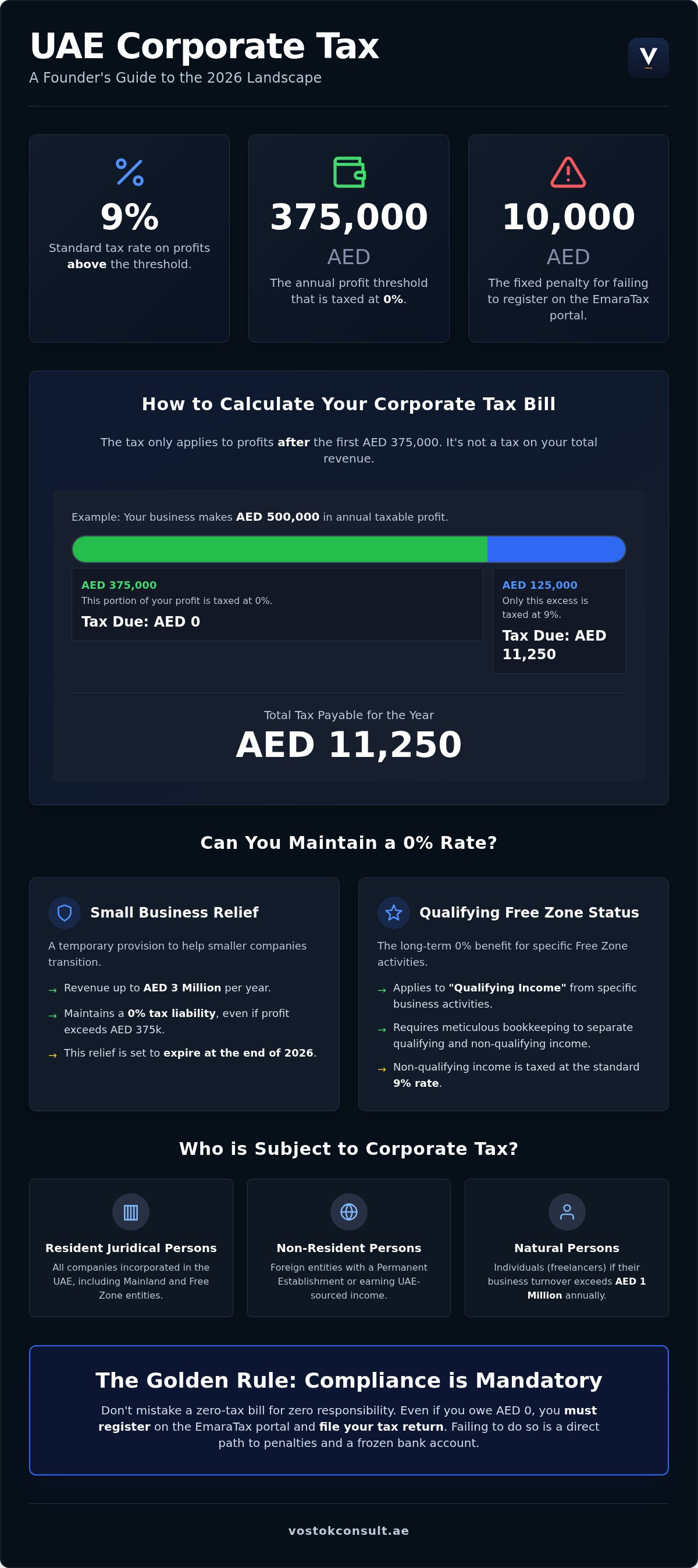
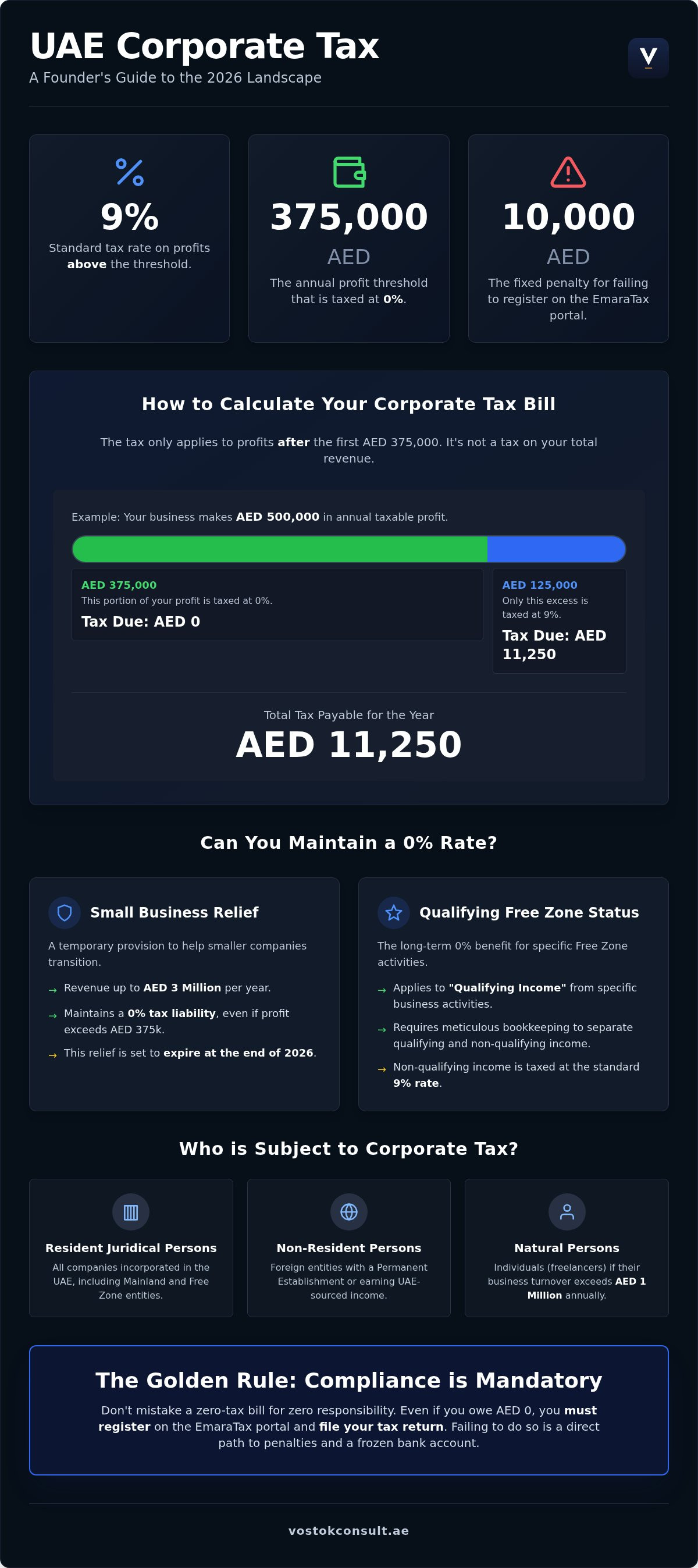
Many founders panic when they see the 9% headline. They assume it's a tax on every dollar they invoice. It isn't. The uae corporate tax is a levy on what you keep, not what you collect. If your business earns AED 2 million but spends AED 1.8 million on legitimate operations, you aren't taxed on the two million. You're taxed on the remaining AED 200,000.
The math is straightforward. The UAE government provides a generous 0% bracket for the first AED 375,000 of profit. This is one of the highest 0% thresholds globally. You only pay the 9% rate on the portion of profit that exceeds this amount. For a clear look at the legal definitions, you can consult the Official UAE Corporate Tax Information portal.
The basic formula for your tax bill looks like this:
- (Total Taxable Profit - AED 375,000) x 0.09 = Your Tax Payable
If your annual profit is AED 500,000, you subtract the AED 375,000 buffer. This leaves you with AED 125,000 of taxable income. At a 9% rate, your total tax bill is AED 11,250. It's a manageable figure for a growing business, provided you've set the funds aside.
Defining Taxable Income
Your taxable income isn't always the same as the profit shown on your internal dashboard. You must start with your accounting net profit and then apply specific adjustments. Some expenses that you might consider "business costs" are not fully deductible under the law. For example, certain entertainment expenses are often capped or restricted. You also need to subtract any exempt income, such as qualifying dividends or capital gains, before arriving at the final taxable figure.
The AED 375,000 Buffer
This threshold is a deliberate safety net for startups and SMEs. It ensures that early-stage founders can reinvest their first few hundred thousand dirhams of profit back into the company without a tax drag. In your first year or two of operation, it's highly likely your tax bill will be zero.
Don't mistake a zero-tax bill for a zero-compliance requirement. You are still legally required to register for uae corporate tax even if you expect to earn far less than the threshold. The Federal Tax Authority needs to see your filing to verify that you fall within the 0% bracket. If you're unsure how to categorize your current expenses to maximize your deductions, you can book a strategy session to review your figures.
Small Business Relief vs. Qualifying Free Zone Status
You might think a Free Zone license is an automatic "get out of tax free" card. It isn't. In 2026, many founders are discovering that the administrative burden of maintaining "Qualifying" status is more expensive than the tax itself. If you're running a lean operation, you need to decide between Small Business Relief (SBR) and the Qualifying Free Zone Person (QFZP) regime.
Choosing the wrong path creates friction. One is based on how much you earn; the other is based on where and how you earn it. You generally cannot claim both. According to the UAE Government Corporate Tax guidelines, these reliefs are designed for different stages of business growth. Picking the wrong one could leave you exposed to an audit you aren't prepared for.
How Small Business Relief Works
Small Business Relief is the "easy" button for uae corporate tax compliance. If your total revenue is AED 3,000,000 or less for a tax period, you can elect to be treated as having no taxable income. This relief is available to both Mainland and Free Zone companies, provided they are resident in the UAE.
The benefits are practical and immediate:
- No complex adjustments for non-deductible expenses are required.
- You pay zero tax regardless of your actual profit margin.
- Filing requirements are simplified compared to the standard regime.
This relief is currently available for tax periods ending on or before December 31, 2026. It's a temporary bridge for startups to find their footing. If you expect your revenue to stay under that AED 3 million mark, this is almost always the most efficient route.
The Free Zone 0% Trap
The Qualifying Free Zone Person (QFZP) status is more permanent but much harder to maintain. To keep your 0% rate, you must prove "Adequate Substance". This means you need a physical office, local employees, and you must conduct your core income-generating activities within the Free Zone. It's a high bar for a remote founder.
Not all income qualifies for the 0% rate under this regime. If you earn money from "Excluded Activities" or trade with Mainland parties, that specific income is taxed at the standard 9%. Many founders get caught out when they realize their consulting work for a Dubai Mainland firm doesn't qualify for the 0% rate.
You should check the 2026 guide for international founders to see the specific list of qualifying activities and rate specifics. If you fail to meet even one requirement, your entire company could lose its 0% status for five years. This is a high-risk gamble if your books aren't perfectly aligned with the latest FTA circulars.
Registration and Filing: The EmaraTax Process
If you're waiting for the Federal Tax Authority to invite you to register, you're making a 10,000 AED mistake. The responsibility to obtain a Tax Registration Number (TRN) sits entirely on your shoulders. In 2026, the "I didn't know" excuse carries a fixed price tag of AED 10,000 for late registration.
Registration for uae corporate tax happens exclusively through the EmaraTax digital portal. It is a streamlined, paperless system, but it requires precision. Every business entity in the UAE, regardless of whether it's in a Free Zone or Mainland, must complete this process to stay compliant and keep their corporate bank accounts operational.
Filing is a separate, recurring task. You must file your tax return and pay any due amounts within nine months from the end of your financial year. If your financial year ends on December 31, your deadline is September 30 of the following year. It's a generous window, but it's one you cannot afford to miss.
Steps to Get Your TRN
The process is methodical. If you have your documents ready, the actual submission is relatively fast. Follow these steps to secure your number:
- Create your account: Access the EmaraTax portal using your UAE Pass. This is the most secure and direct way to link your identity to your business.
- Upload your data: You'll need to digitize your Trade License and Emirates ID. Ensure the scans are clear to avoid manual review delays.
- Submit and track: Once submitted, the FTA typically takes 2-5 working days to approve the application. You'll receive your TRN via email once it's finalized.
Required Documents for 2026
The FTA has tightened its verification process. You need to ensure your documentation is current and reflects your actual corporate structure. Missing a single page from your Memorandum of Association (MoA) can result in a rejected application.
- Trade License: A valid copy from your respective Mainland or Free Zone authority.
- Authorized Signatory Details: A copy of the passport and Emirates ID for the person legally allowed to sign on behalf of the company.
- Proof of Authorization: This is usually your MoA or a specific Power of Attorney.
If you're operating a Mainland entity, refer to our Mainland registration checklist to ensure your corporate structure meets the latest 2026 requirements. Getting the documentation right the first time is the only way to avoid administrative friction.
Staying Compliant Without the Headache
Compliance isn't a one-time setup. It's a recurring hygiene factor for your business. If you treat uae corporate tax as a task you can finish and forget, you're setting yourself up for a sudden administrative freeze. The Federal Tax Authority (FTA) has the power to audit your records at any time. They expect to see clean, professional books that justify every filing you submit.
Your tax status is now directly linked to your financial mobility. UAE banks have integrated tax compliance into their standard risk assessments. To keep your business bank account in good standing, you must provide your Tax Registration Number (TRN) and evidence of filing. If you fail to comply, the bank won't wait for the FTA to act; they'll often restrict your account access to protect their own regulatory standing.
The most efficient way to handle this is to move the burden off your desk. While you focus on scaling your operations, an advisor ensures the deadlines are met and the math is accurate. It's the difference between running a business and managing a bureaucracy. You've built your company to grow, not to get stuck in a portal.
Common Tax Mistakes to Avoid
Founders often trip over the same three hurdles. Avoid these to stay off the FTA's radar:
- The "Exempt" Assumption: Many founders miss the registration deadline because they believe their low profit makes them exempt. Every business must register. No exceptions.
- Expense Bleeding: Mixing personal and business expenses is a major red flag. If you're paying for personal flights or family dinners from the corporate account, those deductions will be rejected in an audit.
- Ignoring VAT: Remember that VAT registration requirements are entirely separate from uae corporate tax. Crossing the AED 375,000 revenue threshold triggers VAT obligations that exist regardless of your corporate tax profit margin.
The Vostok Consult Approach
We act as your frictionless navigator through the EmaraTax system. Our goal is to remove the technical weight of compliance so you can maintain your momentum. We don't just fill out forms; we provide the structural integrity your business needs to thrive in a regulated environment. We speak plainly because we understand the craft deeply enough to simplify it.
- Expert Registration: We handle the entire EmaraTax setup, ensuring your TRN is issued without the usual back and forth with the authorities.
- Strategic Relief: We analyze your revenue and profit to determine if opting for Small Business Relief is your most efficient path for 2026.
- Plain English Clarity: You get direct answers without the legal jargon. We tell you exactly what you need to do and when.
Staying compliant doesn't have to be a bottleneck. If you want to ensure your 2026 filings are handled with professional calm, reach out to discuss your current setup.
Securing Your 2026 Profit Strategy
The transition to uae corporate tax is now a standard part of doing business in the Emirates. It doesn't have to be a bottleneck for your growth. By leveraging the AED 375,000 threshold and the Small Business Relief, you can keep your tax liability low while maintaining the high-speed momentum that brought you to the UAE. The system rewards organization and transparency.
Missing a registration deadline or failing to maintain your books isn't just a compliance risk; it's a threat to your banking relationships and your bottom line. With fixed penalties of AED 10,000 for late filing, the cost of inaction is far higher than the cost of professional support. We offer remote processing and expert guidance from advisors with a deep understanding of both UK and UAE corporate structures.
You can secure your tax registration from AED 1,500 and focus entirely on your scaling efforts. We'll handle the EmaraTax portal and the technical details so you don't have to.
The UAE remains one of the world's most attractive hubs for international founders. With a clear compliance plan in place, you can navigate these changes with confidence and keep your profits protected.
Frequently Asked Questions
Is UAE corporate tax applicable to Free Zone companies?
Yes, every Free Zone entity is considered a taxable person under the law. You are required to register for uae corporate tax regardless of your location. You only benefit from a 0% rate if you meet strict "adequate substance" requirements and earn qualifying income.
What is the deadline for UAE corporate tax registration in 2026?
If you start a new business in 2026, you must register within three months of your incorporation date. For companies established before March 2024, your deadline was determined by your license issuance month. Most of those windows have now closed, so you should check your status immediately.
How much is the penalty for late corporate tax registration?
The Federal Tax Authority imposes a fixed penalty of AED 10,000 for late registration. This fine is applied automatically once your specific deadline passes. Banks often view this penalty as a high-risk indicator, which can lead to restrictions on your corporate account.
Do I need to pay corporate tax if my profit is below AED 375,000?
You pay 0% tax on profits up to this threshold, but you still have to register and file a return. The 9% rate only applies to the portion of profit that exceeds AED 375,000. Filing is mandatory to prove to the authorities that you fall within the 0% bracket.
Can an individual be subject to UAE corporate tax?
Yes, individuals or freelancers are subject to the tax if their annual turnover from business activities exceeds AED 1 million. Your personal salary, dividends, and income from personal real estate investments are generally excluded from this calculation. It only tracks commercial business revenue.
What is Small Business Relief in the UAE?
This relief allows businesses with gross revenue below AED 3 million to be treated as having no taxable income. It's a simplified regime that removes the need to calculate complex tax adjustments. This specific relief is available for tax periods ending on or before December 31, 2026.
Do I need an audit for UAE corporate tax filing?
Not every business needs a full audit, but you must keep clean financial records for seven years. Audited financial statements are a mandatory requirement if you want to maintain "Qualifying Free Zone Person" status for the 0% rate. Most Mainland SMEs can file based on organized internal accounts.
How do I register for corporate tax on EmaraTax?
You must create an account on the EmaraTax portal using your UAE Pass for identity verification. The process involves uploading your current Trade License, Emirates ID, and proof of authorization such as a Memorandum of Association. Most uae corporate tax applications are processed within five working days.
Disclaimer
This article is for general informational purposes only and does not constitute legal, financial, tax, or immigration advice. UAE company formation, visa, licensing, and tax requirements can change and may vary depending on your individual circumstances. Please confirm current requirements with Vostok Consult or the relevant government authority before making any business decisions.