UAE Business Bank Account: 2026 Founder’s Guide

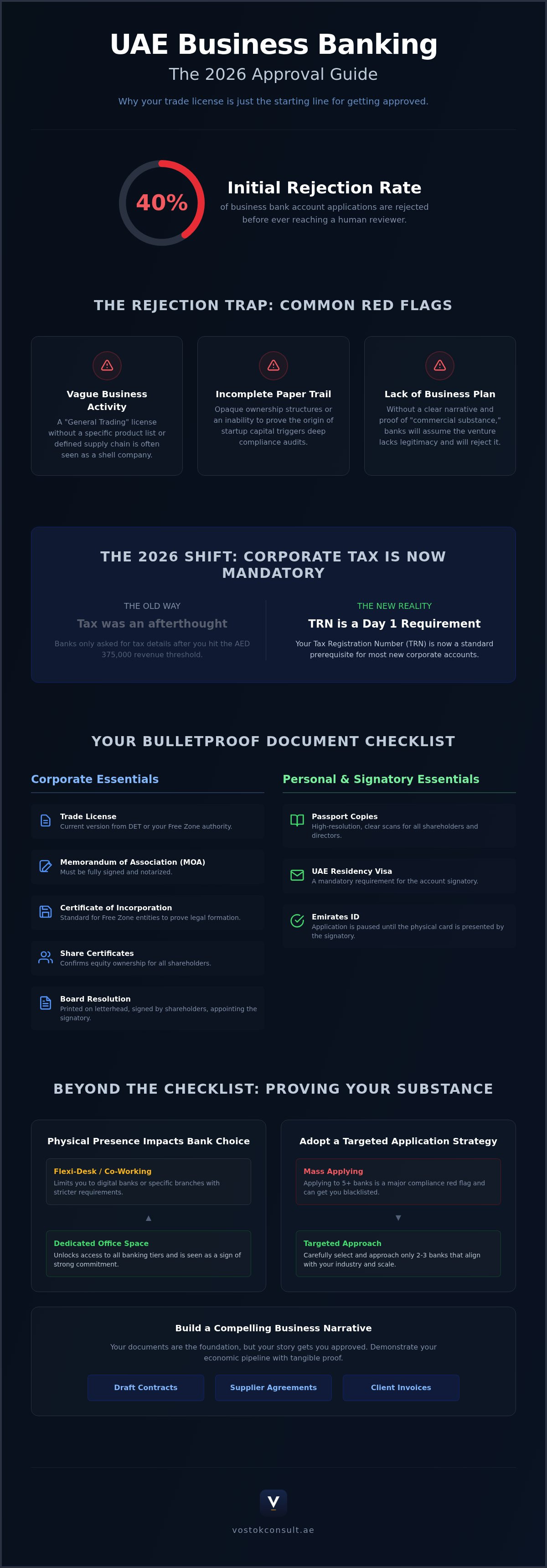
Roughly 40% of initial business bank account applications in the UAE are rejected before they even reach a human reviewer. Most founders assume a trade license is the finish line, but in 2026, it is merely the entry ticket. The real challenge is gathering the correct documents for business bank account UAE approvals while navigating a compliance process defined by vague requests and month-long wait times.
You are likely frustrated by conflicting advice from different jurisdictions and bank officers who cannot explain why your application is stalled. It's a common bottleneck that stops operations and drains momentum. This guide provides a blunt, experience-based breakdown of exactly what UAE banks require to approve your corporate account in the current regulatory climate.
We're moving past the generic checklists to show you how to build a file that actually works. You will learn the logic behind modern KYC requirements, the mandatory role of your 2026 Corporate Tax registration, and the specific narrative you must present to ensure your account is opened. It's time to stop guessing and start following a proven path to approval.
Key Takeaways
- Understand that UAE banking in 2026 is a compliance hurdle rather than a right, requiring a shift from "applying" to "proving" your legitimacy.
- Identify the mandatory documents for business bank account UAE approvals, including your trade license, MOA, and the newly required Corporate Tax registration proof.
- Learn how to build a business narrative that demonstrates "substance" through draft contracts and clear evidence of your economic pipeline.
- Recognize how your physical presence, from a Flexi-desk to a dedicated office, directly impacts which banking tiers will accept your application.
- Adopt a targeted strategy by approaching only 2-3 banks that align with your specific industry to avoid looking like a compliance risk.
The Reality of UAE Business Banking in 2026
In the UAE, a bank account is not a service you buy. It is a privilege you earn. Many founders arrive with a fresh trade license and expect a warm welcome from local branches. The reality is far more clinical. Banks are under immense pressure from the Central Bank of the United Arab Emirates to enforce strict Anti-Money Laundering (AML) protocols.
Every application is viewed through the lens of risk management. You are not just a client; you are a potential liability until proven otherwise. Having the correct documents for business bank account UAE approvals is only 50% of the battle. The other 50% is the narrative you build around those papers. If your file is messy, the bank will simply say no to protect their own license.
The Rejection Trap
Compliance officers look for reasons to reject, not reasons to approve. If your business model is vague, you have already lost. A "General Trading" license is the most common red flag. Without a specific product list and a defined supply chain, the bank sees a shell company and moves on.
Incomplete paper trails are the second biggest killer of new applications. If you cannot prove the origin of your startup capital or the history of your professional background, the process stops. Banks want to see a logical progression from your past experience to your new UAE venture.
-> Opaque ownership structures trigger deep compliance audits.
-> Lack of a clear business plan suggests a lack of commercial substance.
Why 2026 is Different
The introduction of the 9% Corporate Tax changed the banking landscape completely. By 2026, banks expect to see your Tax Registration Number (TRN) almost immediately. They no longer wait for you to hit the AED 375,000 threshold before asking about your tax status or your registration with the Federal Tax Authority.
Digital banks have emerged as a faster alternative, but they are not a shortcut for high-risk businesses. Their filters are automated and unforgiving. If your documents for business bank account UAE don't match their specific data points, an algorithm will reject you in seconds without a chance to explain your case.
-> Proof of VAT compliance is requested much earlier in the business lifecycle.
-> Digital-only banks prioritize low-risk sectors with high transparency.
Understanding these hurdles is the first step toward a successful setup. The next stage is ensuring your paperwork is not just present, but bulletproof. If you want to see how these requirements apply to your specific license, you can view our banking advisory services for a detailed breakdown.
The Essential Document Checklist for Every Application
Collecting the basic documents for business bank account UAE applications is the first test of your patience. Most founders treat this like a simple upload. It isn't. Banks require specific formats, clear scans, and often, legal translations if your parent company is outside the Emirates.
A checklist is just a list until you realize that one missing stamp can delay your setup by weeks. You need the original digital copies and, in many cases, the physical versions ready for inspection. The foundation of your file consists of four core items.
-> Memorandum of Association (MOA) or Articles of Association (AOA). These define your company's rules and must be notarized.
-> Certificate of Incorporation. This is standard for Free Zone entities to prove the legal birth of the company.
-> Share Certificates. These confirm who actually owns the equity. Banks cross-reference these with the MOA to verify ownership.
Personal Identity Documents
The bank needs to know exactly who is behind the money. This starts with high-resolution passport copies for every shareholder and director. These scans must be clear, showing all four corners of the document without any glare.
The account signatory must have a valid UAE Residency Visa and an Emirates ID. Without these, you cannot sign the final application forms. If you are still in the process of obtaining your visa, the bank will pause your application until the physical ID is in your hand.
Corporate Structural Proof
A common mistake is forgetting the Board Resolution. This is a formal document where the shareholders officially appoint the account signatory. It must be printed on company letterhead and signed by all parties. You also need a passport copy for the appointed General Manager, even if they aren't a shareholder.
Proof of address is mandatory for all shareholders. This usually means a utility bill or a personal bank statement. The address on the document must match the address on the application exactly. Discrepancies here are a leading cause of compliance delays.
According to U.S. government trade financing resources, the UAE banking sector is highly sophisticated but remains conservative regarding new account approvals. This conservatism is why your documentation must be flawless from day one.
If you want to ensure your file is ready before you walk into a branch, you can schedule a document review with us.
Beyond the Basics: Proving Your Business Narrative
You have the license and the passport scans. Now comes the part where most founders stumble: proving your business actually exists. A trade license is just a permit to operate. To a compliance officer, it's a blank slate that could be used for anything, including money laundering.
A fresh license with zero history is the hardest to open. Banks in 2026 are obsessed with "Business Substance." They want to see that your company has a logical reason to exist in the UAE and that you have the expertise to run it. Without a clear story, your documents for business bank account UAE applications will likely sit at the bottom of the pile.
Proving your Source of Wealth (SoW) is now mandatory for major shareholders. This isn't just about the money you're depositing today. It's about how you earned your net worth over the last decade. If you can't show a clear, documented history of your professional or entrepreneurial success, the bank will view you as a high-risk entity.
You must also show exactly where the initial startup capital is coming from. If it's a transfer from a personal account, expect to provide six months of personal statements. If a parent company is funding the venture, you'll need audited financial reports. Every dirham must be accounted for before the bank will even consider your file.
The Paper Trail of Legitimacy
Compliance officers aren't industry experts. They won't "get" your business unless you explain it in plain English. Your business plan should be concise, focusing specifically on your UAE operations and target market. Avoid fluff and focus on how you intend to generate revenue within the Emirates.
Many banks, including those following the Emirates NBD business account eligibility standards, now require proof of previous experience. Your CV must reflect expertise in the chosen activity of your new license. If there's a gap between your history and your new venture, you must explain it.
-> Professional CVs for all shareholders showing relevant industry tenure.
-> Past invoices or contracts from your previous companies to prove operational history.
Supplier and Client Lists
Every bank wants to know who you're dealing with. They need to ensure your partners aren't in sanctioned regions or high-risk sectors. Providing a list of potential suppliers and clients isn't just a suggestion; it's often a hard requirement for the "KYC" (Know Your Customer) process.
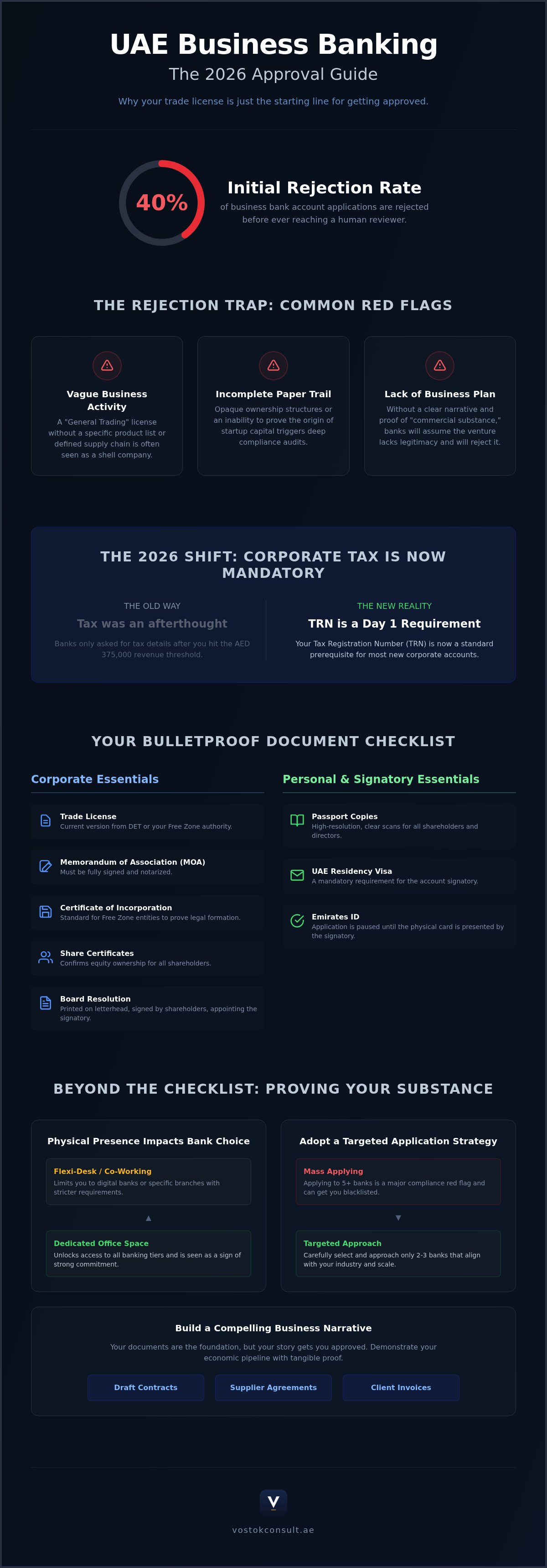
Draft contracts or Letters of Intent (LOI) are the most powerful tools in your arsenal. They prove that you aren't just a "paper company" waiting for something to happen. They show that you have active commercial interest. If you can't provide these, your application will likely be delayed or restricted.
-> Names and target markets for 3-5 potential clients.
-> Signed LOIs or draft service agreements showing imminent business activity.
Building this narrative is what separates a successful application from a rejection. If you're unsure how to document your specific business history, you can explore our file preparation services to ensure your narrative is bank-ready.
The "Hidden" Requirements: Residency and Presence
You have your license and your IDs. You think you're ready. Then the bank asks for a site visit. In 2026, the era of "virtual-only" banking for new corporations is effectively over. Most UAE banks require a demonstrated physical presence before they release your IBAN.
A "Flexi-desk" might get you a trade license, but it won't always get you a bank account. Tier-1 banks often demand a physical office with a dedicated space. If you're in a high-risk sector, like large-scale trading or consultancy with high-value transactions, a shared desk is an automatic rejection. Banks view physical space as a sign of commitment and legitimacy.
The account signatory must have a valid residency visa. While non-resident accounts exist, they are highly restricted and expensive. You'll face higher minimum balances, limited transaction types, and significantly higher fees. For most founders, the "non-resident" route is a dead end that complicates daily operations.
The Ejari or Tenancy Contract
Your Ejari (for Mainland) or Free Zone lease is one of the most critical documents for business bank account UAE approvals. It proves your business has "substance." Don't be surprised if a bank officer visits your office to verify you actually have a desk, a computer, and a sign on the door. They use these visits to ensure you aren't a "brass plate" company.
If your office looks abandoned or lacks basic equipment during an unannounced visit, your application will be flagged for non-compliance. Banks are looking for signs of life. They want to see that you are actually operating from the jurisdiction where you are licensed.
Personal Bank Statements
You must provide 6 months of personal bank statements for all major shareholders. Banks are looking for consistency and a clear financial history. They want to see that the money you're using to start this business was earned through legitimate, traceable means. Large, unexplained cash deposits in your personal history will trigger a request for more evidence.
If these statements are from a foreign bank, they must be in English. If they aren't, you'll need a legal translation. Some banks also require these to be attested by the UAE Embassy in your home country. This adds time and cost to your application, so prepare these files well in advance.
-> 6 months of personal bank statements for shareholders.
-> Physical UAE residency visa for the account signatory.
Ensuring your physical presence matches your documentation is the final hurdle before submission. If your office setup doesn't meet the bank's specific criteria, they won't even process the rest of your file. We can help you determine if your current lease is sufficient for the bank you've chosen.
Preparing Your File: The Path to Approval
Many founders think that applying to every bank in the city increases their chances of success. It doesn't. In the world of UAE compliance, "bank hopping" is a massive red flag. If five different banks see your application at once, you look desperate or like you are trying to find a loophole in the system.
Preparing your documents for business bank account UAE applications is about precision, not volume. You should select 2-3 banks that specifically align with your business activity. Some banks prefer trade; others specialize in tech or professional services. Approaching the wrong department is the fastest way to get a "no" that sticks to your company profile.
You must also ensure your Memorandum of Association (MOA) is technically aligned with your operations. If your MOA is too broad, the bank won't understand your risk profile. If it's too narrow, they may block transactions that don't perfectly match your stated activities. Getting this right before you submit is essential.
Step-by-Step Preparation
The path to an active IBAN is linear. If you skip a step, the process breaks. Follow this sequence to ensure your file is ready for the compliance desk.
-> 2. Secure your UAE residency visa and wait for the physical Emirates ID to arrive.
-> 3. Draft a high-quality business profile and shareholder CVs that prove industry expertise.
-> 4. Organize 6 months of external personal bank statements with clear English translations.
How Vostok Consult Streamlines the File
We don't just hand you a list of documents. We review your entire file with an "advisor eye" to spot the red flags that trigger rejections. We look for inconsistencies in your bank statements, gaps in your CV, and weaknesses in your business plan before the bank ever sees them.
Our role is to match your specific business activity to the right bank and the right department. We maintain direct lines of communication with bank officers who understand the nuances of the 2026 regulatory environment. Our goal is simple: get your file approved on the first attempt without the typical 4-8 week wait times.
If you are ready to move beyond the paperwork and secure your corporate account, you can check our pricing for banking assistance to get started. We focus on the "why" behind the KYC process so you can focus on running your business.
A successful account opening is the final piece of your UAE setup. By following a structured approach and pre-vetting every document, you remove the friction from the system. It is time to stop guessing what the bank wants and start giving them a file they cannot reject.
Securing Your Operational Future
You have the license. You have the vision. But without an active corporate account, your UAE business remains a plan on paper. In 2026, the difference between an approval and a rejection is the strength of your file and the clarity of your commercial narrative.
Successfully organizing your documents for business bank account UAE approvals is the final bridge between setup and scale. You must move beyond basic checklists to prove your economic substance, tax compliance, and professional history. It's about showing the bank exactly why your business is a safe, legitimate partner for their ecosystem.
We provide independent advice focused on your approval rates. From plain English explanations of complex KYC rules to comprehensive support that bridges the gap between licensing and banking, we ensure your application is built to succeed on the first attempt.
The system is complex, but it's navigable with the right preparation. You've done the hard work of launching your venture. Now, let's make sure the banking world is ready to support your growth.
Frequently Asked Questions
Can I open a UAE business bank account without a residency visa?
Opening a corporate account without a residency visa is possible but extremely difficult and restricted. Most local banks will reject non-resident applications for standard business accounts. You'll likely be pushed toward international banks or specific offshore divisions. These accounts often require much higher minimum balances and undergo more intensive background checks on your global assets and professional history.
How long does it take to get a business bank account in the UAE in 2026?
The timeline typically ranges from 2 to 8 weeks depending on your business complexity. Digital banks can sometimes process low-risk applications in 1 to 3 days, but traditional banks take longer for compliance reviews. Providing all mandatory documents for business bank account UAE applications upfront is the only way to avoid month-long delays caused by back-and-forth communication with bank officers.
What is the minimum balance for a corporate bank account in the UAE?
Minimum balances usually range from AED 10,000 to AED 50,000 for standard SME accounts. Priority banking tiers often require AED 150,000 or more. If your balance falls below the agreed limit, banks charge a monthly fee that can range from AED 250 to AED 500. Some digital-first options offer zero-balance accounts, but they may lack essential features like payroll system integration.
Do I need a physical office to open a business bank account?
Most Tier-1 banks now require a physical office with an Ejari or Free Zone lease to prove business substance. While some digital banks accept Flexi-desks, they often limit your transaction volumes or service access. If your activity involves physical trading or high-value contracts, a dedicated office is almost always a non-negotiable requirement for a successful account approval in the current regulatory climate.
Why do UAE banks ask for personal bank statements for a corporate account?
Banks use personal statements to verify your source of wealth and financial stability. They need to ensure the capital used to start the company was earned through legitimate, traceable means. Large, unexplained cash deposits in your personal history can lead to an immediate rejection. They are looking for a logical connection between your past earnings and your new UAE business venture.
What documents are needed for a Free Zone company bank account?
You need the Certificate of Incorporation, Trade License, and the Memorandum of Association. Additionally, provide the Share Certificate and a board resolution appointing the account signatory. Banks also require the standard documents for business bank account UAE signatories, including passport copies, residency visas, and Emirates IDs. If a parent company owns the entity, you'll need the full corporate structure documents attested.
Is it possible to open a UAE business account remotely?
No, the account signatory must be physically present in the UAE to sign the application. While you can start the process and upload documents online, final verification requires a face-to-face meeting with a banker or a biometric scan via a mobile app for specific digital institutions. You cannot complete the entire process from overseas without visiting the Emirates at least once.
Does a Mainland company have better banking options than a Free Zone company?
Mainland companies generally have a smoother path to approval with local Tier-1 banks. These institutions view Mainland entities as having higher local substance because of mandatory office requirements. While Free Zone companies are fully eligible for banking, some banks are more cautious with specific jurisdictions they perceive as having lower compliance standards. Your choice of license location directly influences the bank's risk assessment.
Disclaimer
This article is for general informational purposes only and does not constitute legal, financial, tax, or immigration advice. UAE company formation, visa, licensing, and tax requirements can change and may vary depending on your individual circumstances. Please confirm current requirements with Vostok Consult or the relevant government authority before making any business decisions.