Open Business Bank Account in Dubai Without Residency: 2026 Guide

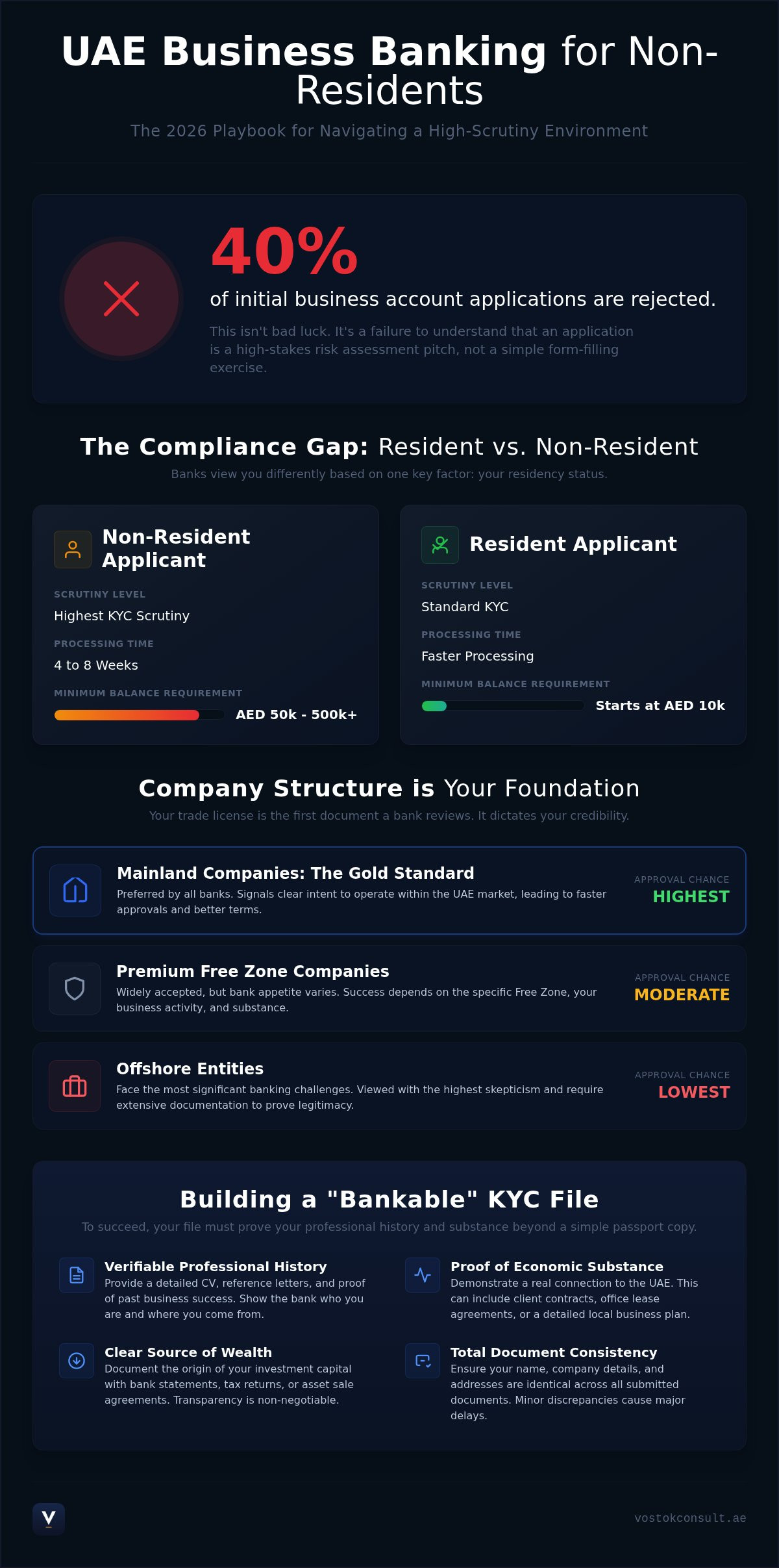
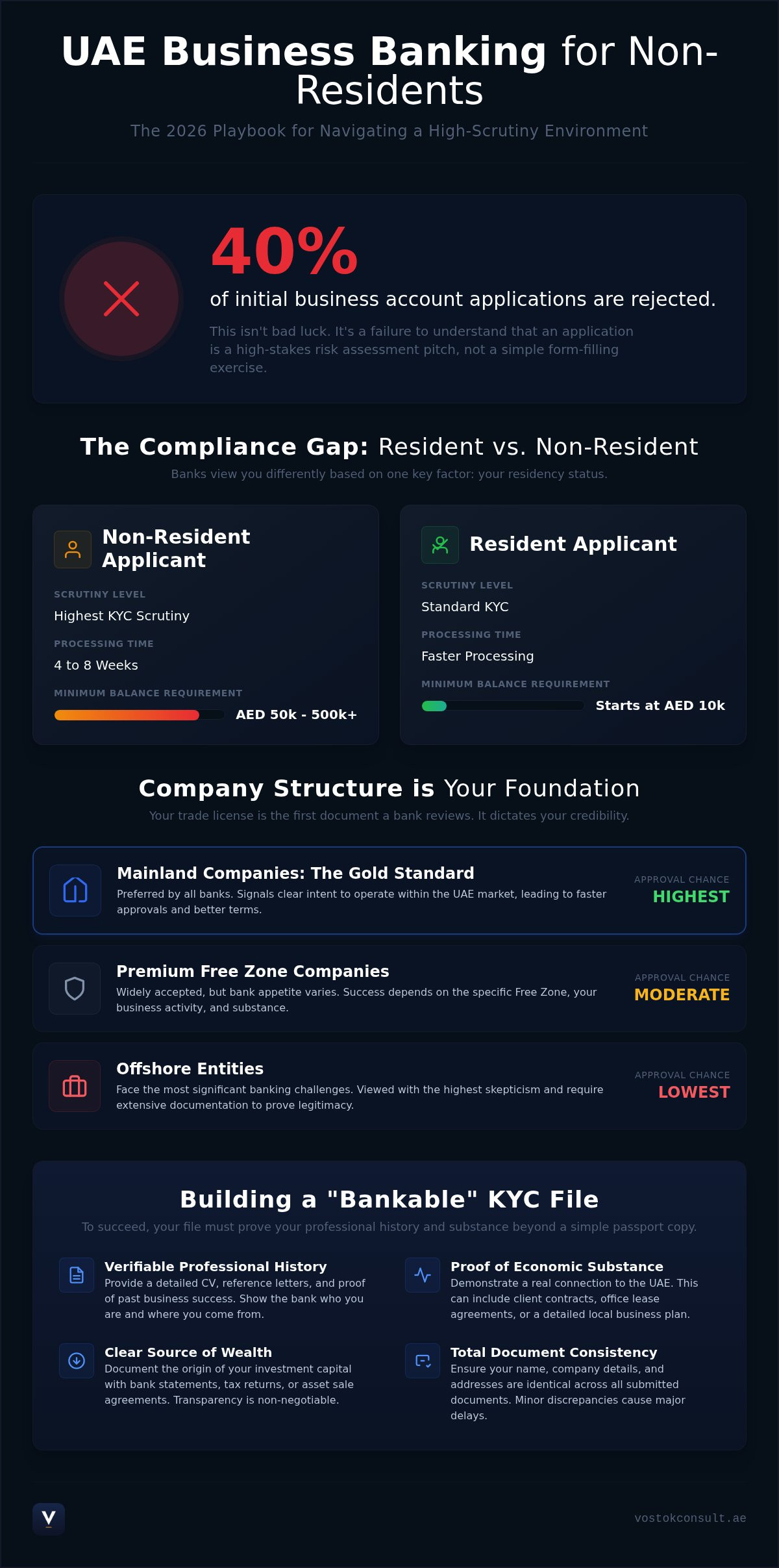
40% of initial business account applications in the UAE end in rejection. Most of these failures are preventable. They happen because applicants treat compliance like a formality rather than a strategy.
If you want to open business bank account in the UAE without residency, you're navigating the most scrutinized path in the system. The 2026 landscape is defined by strict FATF compliance and a demand for high economic substance. You're no longer just filling out forms; you're proving your business belongs in the local ecosystem.
You likely feel the weight of this "black box" already. You face long processing times, silent account managers, and minimum balance requirements that seem to change by the day. It is an inefficient process that drains your time and stalls your global trade operations.
This guide removes the friction. You'll learn exactly how banks profile non-residents and what your KYC file must contain to survive the first review. We will detail the current balance expectations, which can range from AED 50,000 to over AED 500,000, and the logic behind bank approvals. We are moving from confusion to a functional corporate account. Here is the direct path to securing your UAE banking presence.
Key Takeaways
- Analyze why UAE banks reject 40% of applications and how to navigate the heightened KYC scrutiny required in 2026.
- Identify how your company jurisdiction-Mainland, Free Zone, or Offshore-directly impacts your probability of account approval.
- Master the exact steps to open business bank account in Dubai without residency by building a file that proves your professional history beyond a simple passport copy.
- Prepare for the 4 to 8-week processing window by ensuring complete document consistency to prevent avoidable administrative rejections.
- Learn how professional file preparation reduces the risk profile of your non-resident application and aligns your business with specific bank appetites.
The Reality of Opening a UAE Business Account Without Residency
Opening a bank account here is not an automatic right; it is a privilege granted by a compliance officer. Most founders fail because they treat the application like a simple administrative form. In reality, it is a high-stakes risk assessment pitch. If you want to open business bank account in Dubai without residency, you're starting from a position of skepticism in the eyes of the bank.
Banks in the UAE are risk-averse by nature. They operate under strict UAE Central Bank regulations designed to prevent money laundering and ensure global financial integrity. As a non-resident, you trigger the highest level of Know Your Customer (KYC) scrutiny. You are an unknown variable in a system that values local footprint, physical presence, and predictable cash flow.
The 40% rejection rate for initial applications often stems from a simple mismatch between the applicant and the institution. You might have a legitimate, profitable business, but if you apply to a bank whose current "risk appetite" excludes your specific nationality or industry, you'll be rejected. There's no appeal process. Once a rejection is on your record, every subsequent bank will ask why the first one turned you away.
The "High-Risk" Profile Explained
Compliance teams look for red flags before they even read your business plan. Your profile is flagged as "high-risk" if your home country has a low international tax rating or is under increased monitoring. They're searching for structural integrity and a verifiable source of wealth.
- -> AML Compliance: Banks must prove they know the origin of every dirham entering the system.
- -> Tax Residency: Your personal tax jurisdiction affects the bank's international reporting requirements.
- -> Business Activity: High-volume trading often faces more questions than fixed-fee professional services.
Residency vs. Non-Residency Banking
The gap between resident and non-resident banking is measured in both dirhams and time. For a resident with an Emirates ID, minimum balance requirements might start at AED 10,000. If you choose to open business bank account in Dubai without residency, the floor is usually AED 50,000; for many top-tier banks, it exceeds AED 200,000.
Obtaining an Investor Visa changes the conversation immediately. It signals a long-term commitment to the UAE and moves you into a lower risk category. While you can manage an account remotely, most banks still require a one-time physical visit to verify your identity and sign the final board resolution. If you want to avoid months of silent rejection, you can explore our corporate bank account opening assistance to ensure your file is bankable from day one.
How Your Company Structure Dictates Your Banking Success
Your trade license is the first document a compliance officer reviews. It tells them where you are regulated and how much oversight you face. If you intend to open business bank account in Dubai without residency, your company structure is the foundation of your credibility. Banks categorize jurisdictions into risk tiers; Mainland sits at the top, followed by premium Free Zones, with Offshore entities at the bottom.
The bank's decision often happens before they even see your financial history. They are looking for "bankability," which is a measure of how easily they can monitor and audit your operations. A mismatch between your business activity and your jurisdiction is the fastest way to trigger a rejection.
Mainland Companies: The Gold Standard
Mainland companies are preferred by local banks because they demonstrate a clear intent to operate within the local market. This structure allows you to trade anywhere in the UAE and internationally without the restrictions often found in Free Zones. This transparency results in faster approval times and access to higher credit limits.
The "local" factor is critical for non-residents. Banks trust Mainland entities because they are regulated by the Department of Economy and Tourism. According to the UAE Ministry of Economy investment requirements, you no longer need a local partner to manage an LLC, yet the structure remains the most respected in the banking system. Following a UAE mainland company registration checklist ensures you have the specific documents banks expect to see during the onboarding process.
Free Zones and Offshore Hurdles
Not all Free Zones are viewed equally by compliance departments. Some zones have built strong reputations for tech and services, while others are seen as "paper company" hubs. If you choose a zone that does not require a physical office, you're making it harder to open business bank account in Dubai without residency. Banks increasingly demand "economic substance," which a flexi-desk often fails to provide.
- -> Physical Office: A registered lease in a reputable Free Zone significantly improves your risk profile.
- -> Zone Reputation: Banks maintain internal lists of "preferred" and "blacklisted" zones based on historical compliance issues.
- -> Offshore Limits: Offshore accounts are the most difficult to secure locally; most UAE banks refuse non-resident offshore applications entirely.
If you're unsure which jurisdiction fits your banking needs, book a session to review your structure before you commit to a license. Choosing the wrong zone can cost you months in administrative delays and failed applications.
Building a "Bankable" KYC File: What You Actually Need
Many founders hand over a passport and a trade license and expect a quick approval. In 2026, that is a recipe for a quiet rejection. To open business bank account in Dubai without residency, you must present a file that proves your business is real and your wealth is legitimate. Banks are looking for substance, not just a legal entity on paper.
The UAE's push for global investment is clear. Initiatives like the World Bank partnership with UAE highlight the country's commitment to a competitive climate. However, this openness comes with a price: rigorous vetting of foreign capital. If your file is incomplete, a compliance officer will simply move to the next application.
Core Corporate Documents
Your corporate file must be pristine. Any discrepancy between your license and your board resolution will stall the process for weeks. The bank needs to see a clear chain of authority and ownership.
- -> Valid Trade License: This must be current. We typically secure these within 2-8 working days.
- -> MOA and AOA: These documents define your company's rules and ownership structure.
- -> Share Certificate: This is the definitive proof of who actually owns the equity in the business.
For a granular breakdown of every required paper, see our comprehensive list of Documents for Business Bank Account UAE.
The Founder’s Personal File
The bank isn't just vetting your company; they're vetting you. They need to know where your money comes from and if you actually understand the industry you're entering. If you don't live in the UAE, your "substance" is your documentation.
- -> Bank Statements: Provide the last six months of personal or corporate statements from your home country. They look for consistent patterns.
- -> Proof of Address: A utility bill or lease agreement from outside the UAE is mandatory for non-residents.
- -> Professional CV: A LinkedIn profile or CV that aligns with your license activity proves you aren't a front for another entity.
- -> Source of Wealth: Be ready to explain the origin of your initial deposit with invoices, dividend vouchers, or sale-of-asset documents.
Consistency across these files is the only way to open business bank account in Dubai without residency successfully. Incomplete files lead to immediate rejections that are notoriously difficult to appeal. We focus on preparing this file to meet specific bank appetites before the first submission.
The 5-Step Roadmap to Account Approval in 2026
If you think applying to five banks simultaneously increases your chances, you're wrong. It looks desperate to compliance officers. It's a red flag that suggests you're "bank shopping" because you have something to hide. To open business bank account in Dubai without residency, you need a single, surgical strike at the right institution.
Forget the marketing claims of "opening in minutes." For a non-resident, the process realistically takes 4 to 8 weeks. This timeline accounts for the enhanced due diligence required by UAE banks to satisfy international standards. Consistency is your only currency; any mismatch in your story will restart the clock or end the application entirely.
From Preparation to Submission
The first half of the journey happens before you even talk to a banker. You're building a narrative that fits the bank's current risk appetite. Banks change their internal policies monthly; what worked for a founder in January might not work for you in June.
- -> 1. File Preparation: We map your specific business activity to a bank that actively supports that sector. This prevents "auto-rejections" based on industry codes.
- -> 2. Pre-Approval: We send a soft copy of your file for a preliminary check. This is a vital shield that keeps a formal rejection off your permanent record.
- -> 3. Application Submission: Once the soft check clears, we formally lodge the request. This triggers the official KYC review.
Compliance Interviews and Activation
The second half is where the human element enters. You'll likely need to visit the UAE once for a face-to-face meeting. This is a mandatory verification step for most full-service corporate accounts. It's not just a signature; it's an assessment of your professional character.
- -> 4. Compliance Interview: You must answer questions about your suppliers, clients, and projected turnover with total clarity. If you hesitate on where your funds originate, the application dies.
- -> 5. Final Approval and IBAN Generation: After the interview, the file goes to a senior committee. Once cleared, your IBAN is generated and your online banking portal is activated.
Managing these steps alone often leads to silence from the bank. We provide the structural support to keep the process moving. Our banking assistance starts from AED 2,500 and is designed to eliminate the administrative "black hole" that swallows most non-resident applications.
Passing compliance is about preparation, not luck. You need to know exactly what the officer is looking for before you sit down. A single inconsistent answer about your expected annual turnover can trigger an AML investigation that halts your setup for months.
How Vostok Consult Navigates the UAE Banking System for You
Most agencies promise a bank account in a week. They are usually selling a dream that ends in a quiet rejection letter. We take a different approach. We don't just "open accounts." We build bankable business profiles that satisfy the most skeptical compliance officers in the system.
You need a partner who understands the internal mechanics of the UAE's 61 licensed banks. To open business bank account in Dubai without residency, you need more than a courier. You need a navigator who knows which banks are currently onboarding your specific nationality and business activity.
We bridge the gap between complex banking jargon and plain English. Our banking assistance starts from AED 2,500. This investment is designed to save you months of administrative delay and the permanent stain of a rejected application on your corporate record.
Improving Your Approval Odds
We review your home country bank statements before the bank ever sees them. We identify red flag transactions that could trigger an AML query. If we find an issue, we work with you to clarify the narrative before the file is formally submitted.
- -> Strategic Business Plans: We draft a business plan that speaks the language of bank compliance. They want to see trade flows, counterparty risks, and clear economic substance.
- -> Direct Liaison: We maintain relationships with bank managers to track your application in real-time. You won't be left wondering why your file has been "under review" for three weeks.
- -> Risk Mitigation: We identify potential hurdles in your source of wealth documentation early to prevent immediate rejections.
A Full-Service Advisory Approach
Banking is the final step of a successful setup, not the first. We handle the Company Formation process first to ensure your jurisdiction and license activity are aligned with current bank appetites. If you set up the wrong structure, you've already failed the banking test.
Our support doesn't end when your IBAN is generated. We provide ongoing assistance for VAT and Corporate Tax Registration. This ensures your business remains compliant and "bankable" for years to come. You get clear, low-pressure guidance from advisors who have navigated this process hundreds of times.
If you want to open business bank account in Dubai without residency, you need a strategy that accounts for the 40% rejection rate. We provide that strategy. We offer independent advice based on your budget and business goals, ensuring you find the right home for your corporate capital.
Secure Your UAE Banking Presence
Banking for non-residents in 2026 is a game of alignment. You've seen how your company structure acts as the first filter for compliance. You now understand that a passport is just the starting point of a much deeper KYC file. Success depends on presenting a business profile that fits the specific risk appetite of the right institution.
Attempting to open business bank account in Dubai without residency alone often results in wasted time and a permanent rejection on your record. We provide independent advice that matches your budget and business activity. Whether you need a Mainland or Free Zone structure, we ensure your foundation is built for banking approval. Our banking assistance starts from AED 2,500 and provides the direct path through a complex system.
Your global trade operations shouldn't be stalled by bureaucracy. With the right file and a surgical application strategy, you can secure a functional corporate account. We're here to manage the friction so you can focus on your business.
Frequently Asked Questions
Can I open a UAE business bank account entirely remotely?
No, you cannot open a UAE business bank account entirely remotely as a non-resident. While the initial application and document review are digital, nearly all banks require a one-time physical visit to the UAE. You must meet a bank representative to sign the board resolution and verify your original passport. This visit is the final hurdle in the process. Digital-only onboarding is currently reserved for residents with an Emirates ID.
What is the minimum balance required for a non-resident business account?
Minimum balance requirements for non-residents typically range from AED 50,000 to over AED 500,000. Each bank sets its own threshold based on your company's risk profile and chosen jurisdiction. If you want to open business bank account in Dubai without residency, expect these higher entry points compared to resident accounts. Maintaining this balance is critical; falling below the limit often results in monthly penalties or the eventual closure of your account.
How long does it take for a non-resident to get an IBAN?
Expect the process to take between 4 and 8 weeks to open business bank account in Dubai without residency. This timeframe includes the initial file preparation, pre-approval checks, and the final compliance review. Unlike resident applications that can move faster, non-resident files trigger enhanced due diligence. Any inconsistency in your documentation can extend this period by several weeks. We focus on file preparation to ensure your IBAN is generated without unnecessary administrative delays.
Will my account be rejected if I do not have a physical office in the UAE?
A lack of physical office space can lead to rejection, especially for high-risk activities. While some Free Zones offer flexi-desk packages, many banks view these as a lack of economic substance. To improve your approval odds, having a registered lease for a physical office or a dedicated workspace is highly recommended. Banks want to see that your business has a tangible footprint in the UAE rather than just a paper presence.
Do I need to pay corporate tax if I am a non-resident with a UAE account?
Yes, your business must comply with UAE corporate tax laws regardless of your residency status. Since 2023, a 9% tax rate applies to taxable income exceeding AED 375,000. Income below this threshold is taxed at 0%. You must register for corporate tax and file annual returns even if your business qualifies for the 0% rate. Proper registration ensures your banking relationship remains healthy and compliant with federal regulations.
Can I open an account for an Offshore company in the UAE?
Opening a local UAE account for an offshore company is extremely difficult in 2026. Most national banks have ceased onboarding new offshore entities due to strict international compliance standards. If you have an offshore structure, we usually recommend looking at international digital banks or restructuring as a Free Zone or Mainland entity. These structures provide the transparency and local presence that UAE banks require for account approval.
What happens if my business bank account application is rejected?
If your application is rejected, the bank rarely provides a specific reason due to internal security policies. This rejection becomes part of your corporate history in the UAE banking system. Other banks will likely ask if you have been turned down elsewhere. Because there is no formal appeal process, your best strategy is to ensure your file is pristine and bankable before the first submission to avoid a permanent stain on your profile.
Is there a personal income tax for non-residents in the UAE?
There is currently no personal income tax in the UAE for residents or non-residents. You can withdraw dividends or salaries from your corporate account without facing local personal taxation. However, you must consider the tax laws in your home country. While the UAE won't tax your personal earnings, your country of residence might. We recommend consulting with a tax advisor in your jurisdiction to understand your global reporting obligations.
Disclaimer
This article is for general informational purposes only and does not constitute legal, financial, tax, or immigration advice. UAE company formation, visa, licensing, and tax requirements can change and may vary depending on your individual circumstances. Please confirm current requirements with Vostok Consult or the relevant government authority before making any business decisions.