Dubai Free Zone Company Setup Cost: The 2026 Comprehensive Reference
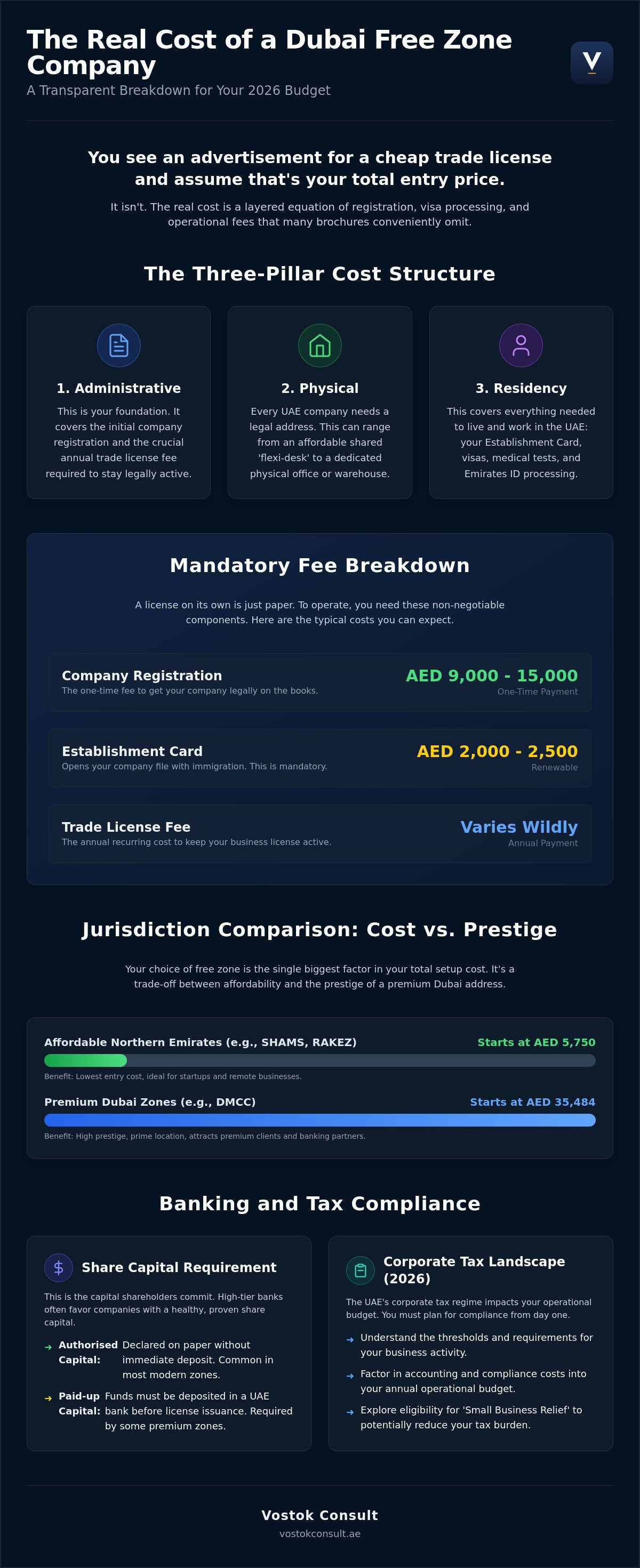
The advertised price for a Dubai free zone company is never the final price. It's the hook. It’s the number you see in big, bold letters, usually under AED 15,000.
The real, all-in cost for your first year is a different figure entirely. It includes your license, your visa, your office, and your compliance. It’s the number you need to budget for, but it’s rarely the number you are shown upfront.
This guide is different. We will break down every mandatory fee you will face in 2026. No marketing spin, just the numbers you need to make an informed decision.
The total cost is a function of four key parts: License + Visa + Space + Compliance. Let’s look at each one.
The Architecture of Dubai Free Zone Setup Costs
Your total setup cost is built on three pillars: administrative, physical, and residency. These are the core components that every free zone authority charges for, in one form or another.
Why do costs vary so much? Because over 40 free zones in the UAE compete for your business. Some sell prestige and location; others sell pure value and efficiency. Your business activity also plays a critical role. A general trading license will always cost more than a specific consultancy permit.
It's crucial to distinguish between one-time registration fees and the recurring annual costs. Your first-year investment is the highest. Year two is significantly cheaper, but you must budget for it.
Fixed vs. Variable Setup Expenses
Your budget will have fixed and variable components. Understanding them prevents surprises.
- One-Time Fees: This is the initial cost to register your company name, prepare legal documents, and file your application with the free zone authority. It's paid once.
- Annual Fees: This is primarily your trade license renewal. Think of it as your yearly fee to the government for the right to operate. It’s a fixed, predictable cost.
- Activity-Based Fees: If you operate in a regulated industry like finance, education, or healthcare, expect additional approval fees from external government ministries. These are variable and depend entirely on your sector.
The Role of the Share Capital Requirement
Share capital is the amount of money invested in your company by its owners. It's a statement of financial standing.
Some free zones require you to prove you have this capital. Others simply state it on your company documents without requiring a deposit. This is the difference between "Paid-up" and "Authorised" capital.
Paid-up capital means you must deposit the funds into your corporate bank account. Authorised capital is simply a declared figure. A higher declared share capital can improve your standing with banks and potential partners, but it’s not always a mandatory cash outlay.
Mandatory Fee Breakdown: License, Registration, and Space
Every single free zone package, no matter the price, is built from the same essential government fees. These are non-negotiable.
Here is the core breakdown:
- Company Registration Fee: A one-time administrative fee paid to the free zone authority to process your application and issue your formation documents.
- Trade License Fee: An annual fee for the license itself. This is the largest part of your recurring cost.
- Office Space Solution: Every company needs a registered address. This can be a simple flexi-desk agreement or a physical office. It's a mandatory annual cost.
- Establishment Card: A mandatory file opened with the immigration department. Without this card, your company cannot apply for residency visas. This is a one-time fee.
Choosing the Right License Type
The type of license you need directly impacts your cost. The choice is determined by what your business actually does.
- Professional License: For service-based businesses, consultants, and specialists. Typically the most affordable option.
- Commercial License: For businesses involved in trading, buying, and selling goods. More expensive due to the broader scope of activities.
- Industrial License: For manufacturing, processing, and assembly. This is the most complex and costly license, often requiring physical warehouse space.
Some free zones offer multi-year license packages, often for 3 or 5 years, at a discount. If you have the capital, paying upfront can save you 15-25% over the long term and protect you from annual price increases.
Office Space and Virtual Desk Requirements
You cannot operate a free zone company without a registered address. This is a legal requirement for substance and compliance.
For most new entrepreneurs, a physical office is unnecessary. The most efficient solution is a flexi-desk.
- Flexi-Desk: This is effectively a shared desk facility that provides you with a legal registered address and access to desk space when you need it. It is the cheapest and most common option for startups and solo entrepreneurs. Expect costs from AED 3,000 to AED 7,000 per year.
- Physical Office: This becomes mandatory if you need to hire a certain number of staff or if your business activity requires a dedicated space (e.g., a clinic or a studio). Costs vary dramatically based on size and location.
Jurisdiction Comparison: Northern Emirates vs. Dubai Premium Zones
Your choice of free zone is a trade-off between price and prestige. A license from a free zone in a Northern Emirate like Sharjah or Ras Al Khaimah performs the exact same legal function as one from a premium Dubai zone. Both give you a 100% foreign-owned UAE company.
The difference is branding, location, and cost.
If your clients are international and you operate remotely, a Northern Emirates free zone offers the best value. If you need a physical presence in the heart of Dubai's business district, you will pay a premium for the location.
Premium Dubai Free Zones: DMCC and Beyond
Jurisdictions like Dubai Multi Commodities Centre (DMCC), Dubai International Financial Centre (DIFC), and Dubai World Trade Centre (DWTC) are considered top-tier.
High-growth tech firms, commodity traders, and large multinational corporations choose these zones for the ecosystem. You are paying for the address, the networking opportunities, and the proximity to central Dubai.
Expect all-in first-year setup costs here to start around AED 50,000 and go up significantly, depending on your office and visa requirements.
Value-Driven Jurisdictions: SHAMS, RAKEZ, and IFZA
Sharjah Media City (SHAMS), Ras Al Khaimah Economic Zone (RAKEZ), and International Free Zone Authority (IFZA) in Dubai are built for efficiency and value.
They offer some of the most competitive setup packages in the UAE, with first-year costs often starting under AED 20,000, including a visa allocation. They are ideal for:
- -> Freelancers and consultants
- -> E-commerce businesses
- -> Service-based entrepreneurs from the UK and Europe
- -> Anyone who does not require a physical office in central Dubai
A major advantage is the ability to complete the entire company setup process remotely. You do not need to visit the UAE to get your license issued.
The 'All-In' Realistic Budget: Visas, Banking, and Compliance
The license fee is just the beginning. To operate legally and live in the UAE, you need to budget for residency, banking, and tax compliance. These are the costs that are often omitted from initial quotes.
This is the final piece of the total cost puzzle.
Residency and Visa Processing Costs
Your trade license allows your company to operate. Your residency visa allows you to live in the UAE. They are separate processes with separate costs.
A typical investor visa package includes several government fees:
- Establishment Card: Around AED 2,000 (one-time).
- Entry Permit: The initial permission to start the visa process.
- Change of Status: An in-country step to activate your entry permit.
- Medical Test & Emirates ID: Mandatory health screening and biometric capture.
- Visa Stamping: The final step where the visa is placed in your passport.
A realistic, all-in budget for one investor visa, including all government fees and processing assistance, is between AED 4,500 and AED 6,500. This is a recurring cost every two years.
Operational Compliance: Tax and Banking
In 2026, simply having a license is not enough. Your company must be compliant with federal regulations from day one.
Corporate Bank Account: Opening a bank account in the UAE has become increasingly difficult due to strict anti-money laundering (AML) and compliance checks. While you can attempt this yourself, many applications are rejected. Professional assistance is critical for most new investors to ensure a successful application. Budget for professional fees in this area.
Corporate Tax: All companies in the UAE must register for Corporate Tax. This is mandatory, even if your profits are below the taxable threshold of AED 375,000. You must register to receive a Tax Registration Number (TRN). You can learn more in our detailed guide to the UAE corporate tax rate.
VAT Registration: If your company's annual revenue exceeds AED 375,000, you are required to register for Value Added Tax (VAT). This involves filing regular tax returns. Failure to comply results in significant penalties.

Navigating the Setup Process with Vostok Consult
This entire process can seem complex. Our role is to make it straightforward.
We provide a single point of contact for the entire setup. We handle the paperwork, the government filings, and the compliance requirements. You deal with one person who manages everything from start to finish.
Our professional fees are transparent and fixed. The price we agree on is the price you pay. No hidden charges.
Our End-to-End Formation Services
We manage the entire lifecycle of your company's formation and ongoing compliance.
- -> We help you select the right jurisdiction based on your budget and business needs.
- -> We handle all document submissions for your license, establishment card, and visas.
- -> We provide expert assistance for opening your corporate bank account.
- -> We manage your mandatory Corporate Tax registration.
- -> We can integrate your free zone entity with a mainland company setup if you need to operate in the local UAE market.
Getting Started: Your Frictionless Transition
The first step is a simple conversation.
We need to understand your business activity, how many visas you require, and your long-term goals in the UAE. From there, we can provide a detailed, all-inclusive quote with a full cost breakdown.
When you're ready to discuss your specific needs, you can schedule a direct consultation with one of our experts.
Book your initial consultation here.
Frequently Asked Questions
What is the cheapest free zone in Dubai for 2026?
The "cheapest" free zone depends on your specific needs, particularly your business activity and visa requirements. Generally, jurisdictions in the Northern Emirates like SHAMS (Sharjah) and RAKEZ (Ras Al Khaimah) offer the most cost-effective packages, often starting under AED 18,000 for a license with one visa eligibility.
Can I set up a Dubai free zone company without a physical office?
Yes. You do not need a physical office, but you are legally required to have a registered address. This requirement is fulfilled by a flexi-desk or shared workspace agreement, which is the most common and affordable option for new businesses.
How much does an investor visa cost in a Dubai free zone?
The total cost for a two-year investor visa, including all government fees, medical tests, and Emirates ID, typically ranges from AED 4,500 to AED 6,500. This is a separate cost from your trade license fee.
Are there any hidden fees in Dubai free zone company formation?
The most common "hidden" fees are costs not included in the initial license quote. These often include the Establishment Card (mandatory for visas), medical test and Emirates ID fees, and professional fees for bank account opening assistance. Always ask for a fully-inclusive quote that covers every step from license to visa in hand.
Do I need a local sponsor for a free zone company setup?
No. This is one of the primary advantages of a free zone. You retain 100% ownership of your company. A local sponsor or service agent is only required for certain types of mainland (onshore) companies.
How long does it take to get a trade license in a Dubai free zone?
The trade license and formation documents can often be issued within 2-5 working days, provided all your paperwork is in order. The entire process, including getting your residency visa stamped in your passport, usually takes 3-4 weeks.
What are the recurring annual costs for a free zone company?
Your main recurring costs will be the renewal of your trade license and your flexi-desk/office lease. You will also have recurring costs for renewing your residency visa every two years.
Is corporate tax mandatory for all free zone companies in 2026?
Yes, registration for Corporate Tax is mandatory for all companies in the UAE. However, you are only liable to pay the 9% tax if your annual net profits exceed AED 375,000. Companies that meet the criteria for a "Qualifying Free Zone Person" may benefit from a 0% rate on qualifying income. We recommend seeking professional corporate tax advisory to ensure you are fully compliant.
Disclaimer
This article is for general informational purposes only and does not constitute legal, financial, tax, or immigration advice. UAE company formation, visa, licensing, and tax requirements can change and may vary depending on your individual circumstances. Please confirm current requirements with Vostok Consult or the relevant government authority before making any business decisions.