Company Formation in Dubai: Which Route Fits Your Business

Most entrepreneurs register a business in the UAE only to realise six months later that their structure prevents them from opening a bank account or trading with local clients. It is a common, expensive mistake. You are likely searching for clarity amidst a sea of conflicting advice, worried about hidden government fees and the complex choice between Mainland and Free Zone jurisdictions.
I spent approximately 20 years as a Quantity Surveyor in UK construction before transitioning into the technical world of company formation dubai. I understand that a business is only as strong as its foundation. This guide moves past the marketing hype to provide the exact steps, real costs, and operational hurdles you will face when entering the market.
We will analyse the specific routes to market, comparing Mainland company formation against Free Zone company formation. We will also address the hurdles of corporate bank account opening and the 9% corporate tax rate. Please note that government fees change frequently and total costs depend on your specific activity, which should be confirmed with Vostok Consult or the relevant authority. You will learn how to navigate the system with the same precision I used on large scale construction projects.
Key Takeaways
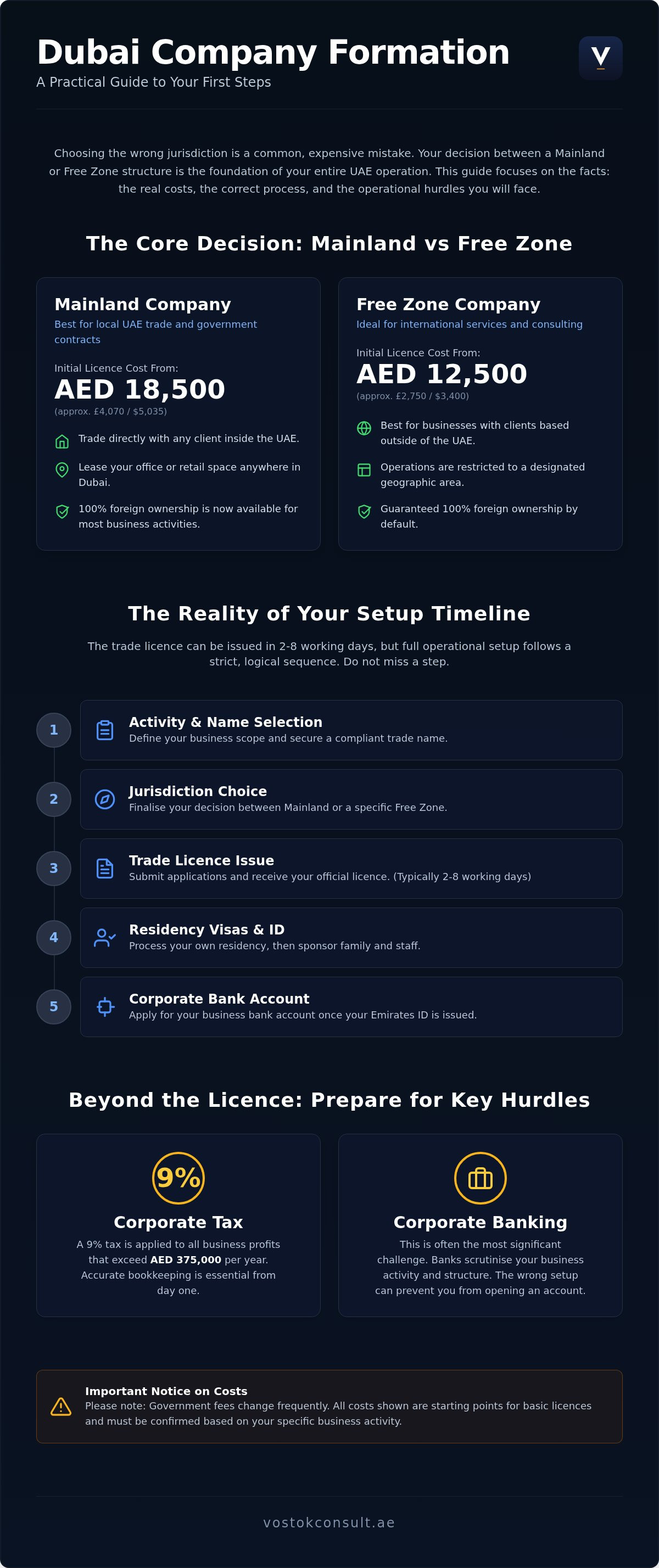
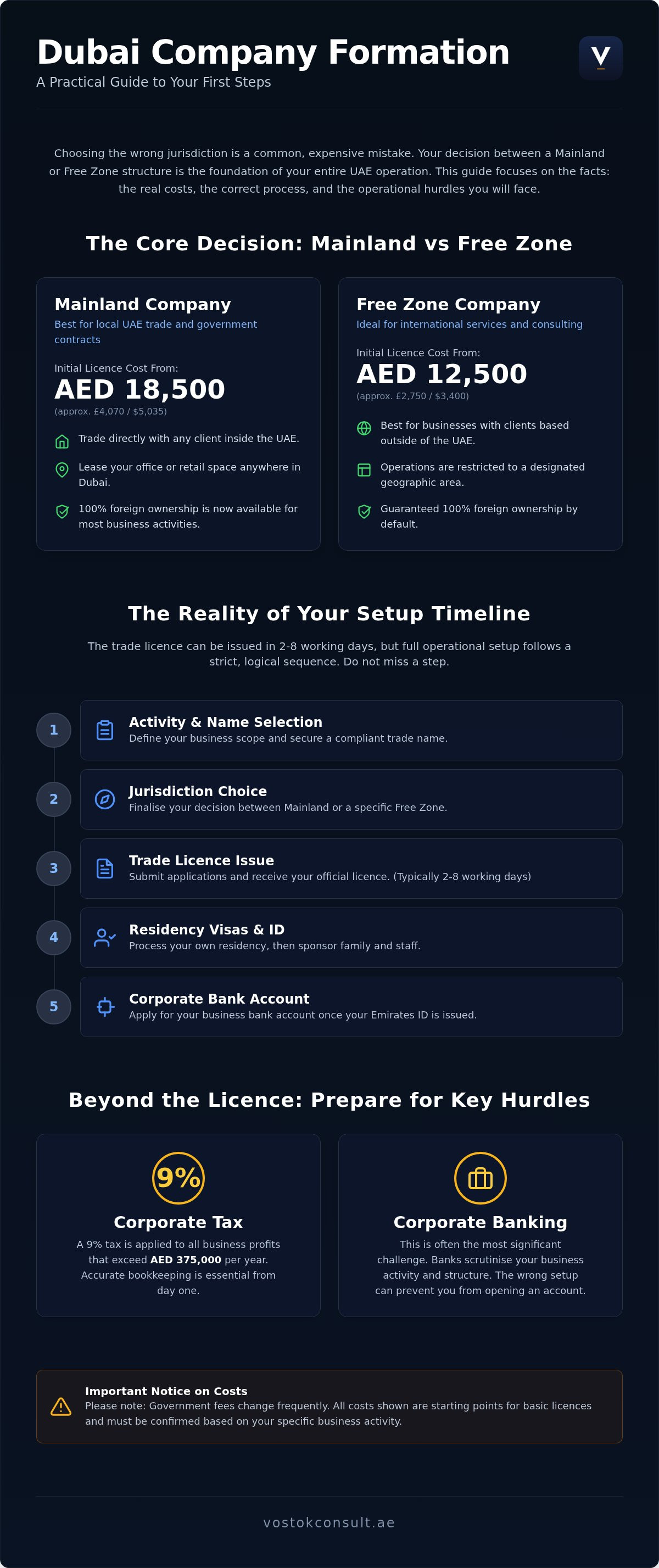
- Decide between Mainland for local UAE trading and government contracts, or Free Zones for 100 per cent foreign ownership and streamlined service setups.
- Identify the technical steps of company formation dubai, where trade licences are typically issued within 2 to 8 working days once the name and activity are approved.
- Budget for initial licence costs starting from AED 12,500 (£2,750 / $3,400) for Free Zones or AED 18,500 (£4,070 / $5,035) for Mainland, whilst accounting for changing government fees.
- Prepare for the most significant operational hurdles, including the 9 per cent corporate tax on profits over AED 375,000 and the complexities of corporate bank account opening.
- Learn why independent, plain English advice is essential to avoid commission-heavy structures that do not align with your long-term business goals.
Choosing Your Jurisdiction: Mainland vs Free Zone vs Offshore
Choosing the wrong jurisdiction is the fastest way to stall your growth. You pick a structure based on where your money comes from, not just the lowest price on a flyer. The process of company formation dubai begins with this single decision. You must determine if you need to trade with the local market or if your clients are entirely international. This choice dictates your tax obligations, your banking options, and your physical footprint in the city.
Your decision rests on three main pillars:
- Target Market -> Local UAE trade requires Mainland; international trade suits Free Zones.
- Office Requirements -> Physical shopfronts are Mainland territory; virtual desks are Free Zone staples.
- Visa Needs -> Mainland offers more flexibility for large staff numbers; Free Zones usually limit visas per square metre of office space.
The Mainland Advantage for Local Trade
If you plan to bid on government contracts or sell products in local malls, you need a Mainland company formation. These licences are issued by the Department of Economy and Tourism (DET). Under current UAE corporate law, most activities now allow for 100 per cent foreign ownership on the mainland. This removes the historic requirement for a local partner in the majority of commercial sectors.
A Mainland licence allows you to lease an office anywhere in Dubai. You aren't restricted to a specific geographic pocket. For a founder, this means you can position your headquarters near your clients or your staff's residential hubs. Costs for a Mainland licence typically start from AED 18,500 (£4,070 / $5,035), though you must realise that government fees change and final totals depend on your specific activity and office lease.
Free Zones and Foreign Ownership
Free Zones are designated areas with their own regulatory authorities. They remain the preferred route for consultants, digital nomads, and international service providers. These zones offer 100 per cent foreign ownership by default and often provide streamlined, remote setup processes. You can find the right fit by reading our guide on the best free zone in UAE for startups.
While Free Zones are efficient, they limit your ability to trade directly with the local UAE market without a distributor or a Mainland branch. If your revenue is generated outside the UAE, a Free Zone is often the most cost effective path. Setup costs in popular zones like Meydan start from approximately AED 12,500 (£2,750 / $3,400).
Offshore structures are a third, more niche option. They serve best as holding companies for asset protection or intellectual property. They do not provide residency visas and do not require a physical office. Before committing to a jurisdiction, verify which one aligns with your banking requirements, as banks often have strict preferences for certain zones.
The Step-by-Step Reality of Dubai Company Setup
Competitors often promise instant setups. This is misleading. Whilst the initial trade licence can be issued in 2 to 8 working days, the full operational cycle involves a logical sequence of approvals. You must complete each stage correctly to avoid delays in your residency or banking. The process of company formation dubai follows this technical path:
- Activity and Name -> Select your business scope and secure a compliant trade name.
- Jurisdiction -> Choose Mainland or a specific Free Zone based on cost and target market.
- Licence -> File approvals and wait for the trade licence to be issued.
- Visas -> Process residency for yourself, your family, and your team.
- Bank Account -> Apply for your corporate account once your Emirates ID is issued.
The World Bank's Doing Business report has historically noted the procedural steps required in the UAE. Success depends on the quality of your initial application rather than just the speed of filing. If you want to ensure your activity list is bank-compliant from day one, you can book a technical consultation to review your plan.
Selecting Your Business Activities
The UAE uses a specific list of permitted activities for every licence. You cannot simply describe your business in your own words; you must match it to a recognised code. Choosing the wrong activity is the most common reason for bank account rejections later. Banks categorise certain activities as high risk, which can lead to months of delays or a flat refusal. Review the UAE mainland business activities list to ensure your scope aligns with both your operations and banking requirements.
Trade Name Compliance Rules
Your trade name must meet strict government criteria. It cannot be already in use by another entity or contain offensive language. You must avoid using names of countries, such as "British" or "American", or global brands without specific permission from the authorities. If you use your own name, it must be your full name, not just a surname or initials. Government fees for trade name registration are mandatory and change frequently. You should confirm the current rates with the relevant authority or your adviser before filing. Once the name is reserved, you can move to the formal licence application.
Understanding the Real Costs: Licences, Visas, and Hidden Fees
You see low prices on billboards, but the final invoice is often double. Most agencies advertise a "licence only" price to get you through the door. They ignore the mandatory immigration and medical fees that every founder must pay. Transparency is the only way to plan a successful company formation dubai. If you don't budget for the full lifecycle of the setup, you will find your capital depleted before you even open your bank account.
Your primary expense is the trade licence itself. These costs vary significantly based on your chosen jurisdiction and the number of visas you require. For context, I often compare these to "pre-construction costs" in my previous 20 years of UK surveying. They are the fixed foundations of your project. The starting points for core licences are:
- Free Zone Licence (e.g., Meydan) -> From AED 12,500 (approx. £2,750 / $3,400).
- Mainland Licence (DET) -> From AED 18,500 (approx. £4,070 / $5,035).
- Offshore Licence -> From AED 9,500 (approx. £2,090 / $2,585).
Mandatory Government and Immigration Fees
A licence alone does not grant you residency. You must factor in the visa processing costs for yourself and any partners. These are separate from the licence fee and are paid to the Federal Authority for Identity, Citizenship, Customs and Port Security (ICP) or the relevant Free Zone authority. You must realise that government fees change regularly. These figures represent the state's charges and exclude any professional consultancy fees.
The standard residency costs include:
- Investor or Partner Visa -> From AED 4,000 (approx. £880 / $1,085) per person.
- Immigration Establishment Card (one-time) -> From AED 2,000 (approx. £440 / $545).
- Emirates ID and Medical Exam -> From AED 2,250 (approx. £495 / $610).
The Establishment Card is a mandatory document that allows your company to register with the immigration department. Without it, you cannot sponsor staff or yourself. The medical exam and Emirates ID process require your physical presence in the UAE for biometric scanning and blood tests.
The Multi-year Discount Strategy
If you have a long-term plan, don't pay annually. Committing to a two or three-year licence can reduce your total costs by 15 per cent. This is a significant saving for established businesses looking to lock in current rates. It also reduces the administrative burden of annual renewals. You can view a full UAE free zone license cost breakdown to compare multi-year options across different zones. This strategy ensures you aren't surprised by price hikes in the following year, providing better financial predictability for your first 36 months of operation.
Beyond the Licence: Banking, Tax, and Residency
Obtaining your trade licence is only half the battle. Many founders celebrate their licence issuance only to find themselves stuck with a "paper company" that cannot move money. This is the reality of company formation dubai. You must look beyond the paperwork to the operational pillars of banking and tax. A business that cannot transact is a liability, not an asset.
Opening a corporate bank account is the most challenging part of the setup. Unlike the licensing process, which is largely objective, banking is highly subjective. Banks in the UAE are the ultimate gatekeepers. They require a comprehensive file including proof of residence, source of wealth, and a clear business plan. Poorly prepared applications are frequently rejected with no right of appeal. If you fail with one major bank, your record remains in the system, making subsequent attempts harder.
Winning Approval for Your Corporate Bank Account
Banks operate under strict Know Your Customer (KYC) regulations. They want to see that your business has a genuine economic purpose. You must prove your professional background and show where your initial capital originated. I often assist clients in structuring these files with the same level of detail I used for technical audits during my 20 years in UK construction. Review the Dubai corporate bank account requirements to ensure your file is compliant before you submit it to a relationship manager.
Taxation and Compliance
The UAE is no longer a tax-free environment for companies. Since financial years starting on or after 1 June 2023, UAE Corporate Tax is 9 per cent on taxable profits exceeding AED 375,000 (£82,500 / $102,000). While a 0 per cent rate applies to profits below this threshold, you must still register for tax. Additionally, VAT registration is mandatory if your taxable turnover exceeds AED 375,000 per year. Most setup steps are remote, but you must visit the UAE for biometrics and medical checks to finalise your residency status.
Residency Visas and the Golden Visa Route
Your licence allows you to apply for residency. Investor visas typically provide residency for two years and are renewable indefinitely. For those making significant investments or possessing high-level talent, the Golden Visa offers a 10-year residency. This longer-term visa provides greater stability and removes the need for frequent renewals. You can also sponsor your family members once your own residency is active and your Emirates ID has been issued. This process requires a separate medical check and biometric appointment in a government centre.
Choosing an Advisor: The Vostok Consult Difference
Most setup agents in the UAE act as commission-based sales representatives for specific Free Zones. They will push you toward the jurisdiction that pays them the highest referral fee, regardless of whether that structure supports your banking or trading needs. This conflict of interest is the primary reason why company formation dubai often leads to operational dead ends. You need an advisor who prioritises your long-term functionality over a quick licence sale.
My approach is rooted in approximately 20 years as a Quantity Surveyor in UK construction. In that industry, precision and clear documentation are the difference between a successful project and a total failure. I brought this technical mindset to the UAE to navigate a system that is often wrapped in jargon and hidden costs. We use plain English to explain complex regulations so you understand your obligations before you sign a single contract.
A Technical Approach to Business Setup
We focus on the operational health of your business, not just the issuance of a trade licence. A licence is a minor hurdle; the real challenge lies in bank-compliant structures and tax alignment. My background in UK construction means I value the "as-built" reality of your company. We do not hold any specific professional memberships, charterships, or regulatory licences. Instead, we offer decades of practical experience in managing complex projects and navigating bureaucratic systems. We provide a single point of contact for the entire process:
- Strategic jurisdiction selection based on your target market.
- Trade licence issuance, typically within 2 to 8 working days.
- End-to-end processing for investor and employment visas.
- Corporate bank account opening and tax registration support.
Remote Setup for International Founders
You can start your business from your home country without travelling to the UAE immediately. We manage the initial filings and approvals remotely, ensuring your company is legally established before you even board a plane. This remote-first capability saves you significant time and accommodation costs. Once the licence is issued, one short visit is usually enough to complete your biometrics, medical checks, and bank meetings. You can get started today by booking a consultation to discuss your specific goals. We will provide a transparent breakdown of all costs, whilst noting that government fees change frequently and must be confirmed at the time of filing.
Building Your UAE Foundation with Precision
Setting up a business in this market requires more than a trade licence. You must align your jurisdiction with your banking requirements and tax obligations from the start. My 20 years of professional background in UK construction taught me that a project is only as good as its technical specifications. This applies directly to company formation dubai.
By choosing a structure that fits your specific activity, you can secure trade licences in 2 to 8 working days and access 15 per cent multi-year discounts. This ensures your capital is preserved for growth rather than lost to administrative errors or changing government fees. You now have the roadmap to move from a concept to a fully operational entity.
I look forward to helping you establish a stable and profitable presence in the UAE market.
Frequently Asked Questions
How long does company formation in Dubai take?
Trade licences for company formation dubai are typically issued within 2 to 8 working days. This timeframe covers the initial registration and name approval. However, you must account for the subsequent stages, including the immigration establishment card, medical checks, and Emirates ID processing. These additional residency steps usually add another 10 to 15 working days to the total timeline. Banking remains the final hurdle and follows its own independent schedule.
Do I need a physical office to set up a Dubai company?
Your requirement for a physical office depends on your chosen jurisdiction. Mainland companies must generally have a physical office lease registered through Ejari. Free Zones are more flexible, offering "flexi-desk" or "smart office" packages that satisfy legal requirements without the cost of a large private space. If you intend to sponsor more than three employees, you will likely need to upgrade to a physical office to meet visa allocation rules.
Can I get 100 per cent ownership of my Dubai business?
You can now achieve 100 per cent foreign ownership for the vast majority of business activities in both Mainland and Free Zone jurisdictions. The 2020 amendment to the Commercial Companies Law removed the requirement for a local Emirati partner for most mainland commercial licences. Only a small number of strategic sectors, such as defence or telecommunications, remain restricted. This change has made the decision between jurisdictions purely about operational needs rather than ownership control.
What are the main differences between Mainland and Free Zone?
The primary difference is where you are permitted to trade. A Mainland licence allows you to trade anywhere in the UAE and bid for government contracts without restrictions. Free Zone companies are designed for international trade or service provision within their specific zone. Whilst Free Zones offer easier remote setups, they require a local distributor or a Mainland branch to sell physical goods directly into the local UAE market.
How much does it cost to set up a business in Dubai?
Costs vary based on your activity and visa requirements, but core licence prices are fixed. A Free Zone licence typically starts from AED 12,500 (£2,750 / $3,400), whilst Mainland licences start from AED 18,500 (£4,070 / $5,035). You must also budget for mandatory residency costs, such as the medical and Emirates ID, which start from AED 2,250 (£495 / $610). Always realise that government fees change frequently and should be confirmed at filing.
Is a visit to the UAE mandatory for company setup?
You can complete the initial stages of company formation dubai remotely from your home country. We handle the name reservation and licence issuance without you needing to travel. However, you must visit the UAE to complete the mandatory medical exam and biometric scanning for your Emirates ID. Most corporate banks also require a physical meeting with the company's shareholders before they will finalise the opening of your business account.
What is the corporate tax rate in the UAE for 2026?
The UAE corporate tax rate is 9 per cent on taxable profits exceeding AED 375,000 (£82,500 / $102,000). A 0 per cent rate applies to profits below this threshold to support smaller enterprises. For the 2026 tax period, companies with revenue under AED 3 million may also apply for Small Business Relief. Even if your profits fall below the threshold, you are still legally required to register with the Federal Tax Authority.
Can I open a corporate bank account as a non-resident?
Opening a corporate account as a non-resident is technically possible but carries a high rejection rate. Banks in the UAE prioritise applicants who have a residency visa and a local Emirates ID. Without residency, the KYC requirements become significantly more stringent and the minimum balance requirements often increase. We recommend securing your residency visa first to demonstrate a genuine link to the UAE, which greatly improves your chances of banking approval.
Disclaimer
This article is for general informational purposes only and does not constitute legal, financial, tax, or immigration advice. UAE company formation, visa, licensing, and tax requirements can change and may vary depending on your individual circumstances. Please confirm current requirements with Vostok Consult or the relevant government authority before making any business decisions.